

Table of Contents
- Bruges at a Glance: Highlights and Visitor Tips
- Exploring Bruges by Wheelchair: How Accessible Is the Old Town
- Getting to Bruges
- Accessible Toilets in Bruges
- Brochure “Bruges, accessible for everyone”: Your Guide to a Barrier-Free Visit
- Custom Wheelchair-accessible Tour
- Overview of the Wheelchair-accessible Walking Tour
- Concert Hall (Concertgebouw Brugge)
- St. Saviour’s Cathedral (Sint-Salvatorskathedraal)
- Church of Our Lady (Onze-Lieve-Vrouwekerk)
- St. John’s Hospital (Sint-Janshospitaal)
- Provincial Court (Provinciaal Hof)
- Historium Brugge
- Basilica of the Holy Blood (Basiliek van het Heilig Bloed)
- City Hall (Stadhuis)
- Brewery „Bourgogne des Flandres“
- Groeninge Museum
- BRUSK Art Hall (Opening May 8, 2026)
- Additional Wheelchair-Accessible Attractions
- Zeebrugge – wheelchair-accessible beach
- Comments [0]
Back to:
Bruges at a Glance: Highlights and Visitor Tips
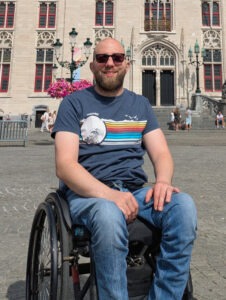
Bruges is the capital of the province of West Flanders, located in the northwest of Belgium, about 12 miles (20 kilometers) from the sea. The city is best known for its medieval old town and its many canals, which have earned Bruges the nickname “Venice of the North.” Most of the buildings you can visit today date back to the 14th and 15th centuries, the city’s heyday. At that time, Bruges was an important trading hub and renowned for its cloth production.
With 8.3 million visitors in 2023, Bruges is no longer a hidden gem. During peak season it can get quite crowded, but it’s still worth it! The carefully restored buildings and the unique atmosphere created by the canals make a visit a truly memorable experience.
If you want to experience Bruges at a relaxed pace, the best time to visit is in late spring or early autumn. Weekends, including Fridays, are best avoided. From Monday to Thursday, it’s much quieter, giving you the chance to enjoy the canals, narrow streets, and cafés at your leisure.
Exploring Bruges by Wheelchair: How Accessible Is the Old Town
Most of Bruges’ main attractions are located close to each other, making them easy to explore on foot or by wheelchair. Another advantage for wheelchair users is that the old town is almost entirely flat, so there are very few slopes to navigate. Only a few steep entrance ramps may require some assistance from a companion.
Cobblestones

One major consideration for wheelchair users is the cobblestones in the old town. But don’t worry: for the most part, they’re manageable, even if the ride can get a bit bumpy. True historic cobblestones, where the front wheels of your wheelchair might get stuck, are mostly found in the Beguinage, which is why we don’t recommend visiting that area.
Visitor Flows
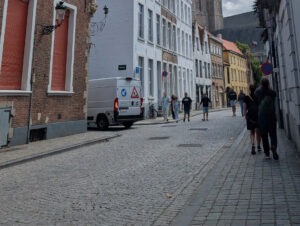
Not all areas of the old town are pedestrian zones. Outside these zones, cars pass through regularly, so the streets aren’t a real alternative to the sidewalks. The sidewalks themselves can become very crowded during peak times, making it difficult to navigate by wheelchair. For a more relaxed visit, try to plan your trip outside of these busy periods.
Boat Tour
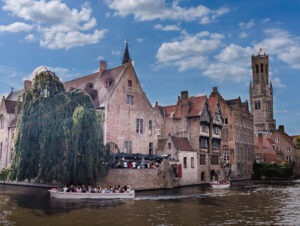
For most visitors, a boat tour along Bruges’ famous canals is an absolute must. Unfortunately, there are no lifts or other aids to make boarding easier. This means you can only join if you still have sufficient mobility. For most wheelchair users, a boat tour is likely not feasible.
Getting to Bruges
Bruges is very popular with visitors, so the tourist office usually recommends arriving by train. However, we weren’t sure if that would work smoothly with a wheelchair, so we decided to drive anyway – knowing that finding a parking space might take a little longer.
By Car: Parking and Accessible Spaces
To make finding a parking spot easier, we recommend using the digital map of all public accessible parking spaces in Bruges (website in Dutch). For better orientation, simply select „Brugge“ under “Filter op Gemeente” in the menu on the left.
Since public accessible parking spaces are limited due to the high number of tourists, private parking garages are often a more convenient alternative. A recommended option is the ’t Zand garage, located directly beneath the concert hall – the starting point of the walking tour. It offers a total of 1,887 spaces, including 14 designated for wheelchair users. To ensure a spot is available, you can reserve a space online in advance, although this requires booking a specific time slot.
Unlike Brussels and Antwerp, Bruges does not have an environmental zone for cars.
By Train: Accessible Station and Connections to the City Center
The accessible Bruges train station is located about 0.5 miles (800 meters) from the concert hall, the starting point of our walking tour. To plan a barrier-free journey by train, Belgium’s SNCB/NMBS offers various assistance services for passengers with reduced mobility.
Right in front of the station is the bus terminal. Most buses are low-floor vehicles with ramps and kneeling systems, allowing for accessible boarding. However, they only travel to the outskirts of the historic old town. The easiest way to plan your bus trip is through the De Lijn app. Accessible stops are marked with a wheelchair symbol in the route planner. More information is available in the accessibility FAQ on the De Lijn website.
Accessible Toilets in Bruges
A full bladder on bumpy cobblestones is no fun – especially if it tends to trigger spasms. To spare you that experience, we’ve linked an interactive map showing all public accessible toilets in Bruges, along with their opening hours:
- Map of Public Accessible Toilets (website in Dutch)
In addition, we’ve compiled detailed information on the most important accessible toilets. Most of the information here comes from the brochure „Bruges – Accessible for Everyone“ and from the Toegankelijk Vlaanderen website – which, unfortunately, is no longer online. All toilets mentioned here are marked with the 🚻 symbol throughout the text.
Accessible Toilet – Centrum Parking – ’t Zand (Above Ground)
- Address: ‚t Zand, 8000 Brugge
- Access: Paid
- Narrowest Entrance to Toilet: 31.5 in (80 cm)
- Clearance in Front of Toilet Bowl: 44.9 in (114 cm)
- Approach to Toilet Bowl: from the left (44.5 in / 113 cm)
- Grab Bars at Toilet Bowl: 1 fold-down grab bar and 1 wall-mounted grab bar
- Sink: partially wheelchair-accessible (limited space underneath)
Accessible Toilet – Near the Gruuthuse Museum
- Address: Dijver 17c, 8000 Brugge
Location: Opposite the reception pavilion of the Gruuthuse Museum - Access: Paid
- Narrowest Passage to Toilet: 32.7 in (83 cm, at the payment counter)
- Clearance in Front of Toilet Bowl: 54.3 in (138 cm)
- Approach to Toilet Bowl: from the right (39.4 in / 100 cm)
- Grab Bars at Toilet Bowl: 2 fold-down grab bars
- Height of Toilet Bowl: 20.9 in (53 cm)
- Sink: partially wheelchair-accessible (limited space underneath)
Accessible Toilet – Belfry (Courtyard)
- Address: Markt 7, 8000 Brugge
- Access: Paid
- Narrowest Passage to Toilet: 35 in (89 cm)
- Clearance in Front of Toilet Bowl: 56.7 in (144 cm)
- Approach to Toilet Bowl: 40.6 in (103 cm)
- Grab Bars at Toilet Bowl: 2 grab bars
- Sink: fully wheelchair-accessible underneath
Accessible “Toilet for All” – Provincial Court (2nd Floor)
- Address: Markt 3, 8000 Brugge
Location: Door to the elevator to the right of the main entrance with stairs - Features: Toilet with height-adjustable adult changing table and ceiling lift (“Toilet for All”)
- Access: Free, registration at the reception (ground floor)
- Narrowest Passage to Toilet: 35.4 in (90 cm)
- Clearance in Front of Toilet Bowl: 59 in (150 cm)
- Approach to Toilet Bowl: from both sides
- Grab Bars at Toilet Bowl: 2 fold-down grab bars
- Height of Toilet Bowl: 18.5 in (47 cm)
- Sink: wheelchair-accessible underneath
Accessible Toilet – Provincial Court (Basement)
- Address: Markt 3, 8000 Brugge
Location: Door to the elevator to the right of the main entrance with stairs - Access: Paid
- Narrowest Passage to Toilet: 35.4 in (90 cm)
- Clearance in Front of Toilet Bowl: 47.2 in (120 cm)
- Approach to Toilet Bowl: from the left (37.4 in / 95 cm)
- Grab Bars at Toilet Bowl: 1 fold-down grab bar and 1 wall-mounted grab bar
- Height of Toilet Bowl: 18.5 in (47 cm)
- Sink: wheelchair-accessible underneath
Accessible Toilet – Minnewater (Lake of Love)
- Address: Begijnvest 1, 8000 Brugge
- Access: Paid
- Narrowest Passage to Toilet: 30.3 in (77 cm)
- Limited Turning Space in Front of Toilet Door: 43.3 in (110 cm)
- Clearance in Front of Toilet Bowl: 35.4 in (90 cm)
- Approach to Toilet Bowl: from the left (39.4 in / 100 cm)
- Grab Bars at Toilet Bowl: 1 fold-down grab bar and 1 wall-mounted grab bar
- Height of Toilet Bowl: 20.9 in (53 cm)
- Sink: partially wheelchair-accessible (limited space underneath)
Brochure “Bruges, accessible for everyone”: Your Guide to a Barrier-Free Visit
The brochure “Bruges, accessible for everyone“ is the perfect companion if you want to explore the city barrier-free.
It includes:
- A fully accessible walking tour of the old town
- Detailed information on museums, attractions, cafés, restaurants, and accommodations — including accessibility details
- An overview of accessible toilets, tourist information offices, care services, and mobility aids
- Practical tips on getting around and parking
The brochure is available as a free PDF download or at one of Bruges’ tourist information offices.
Based on the brochure’s walking tour and our on-site experience, we have optimized the route to be fully wheelchair-accessible.
Custom Wheelchair-accessible Tour
Sie sehen gerade einen Platzhalterinhalt von komoot. Um auf den eigentlichen Inhalt zuzugreifen, klicken Sie auf die Schaltfläche unten. Bitte beachten Sie, dass dabei Daten an Drittanbieter weitergegeben werden.
Mehr InformationenInformation about komoot
A larger map is available via the link “View all details of this tour.” No Komoot account is required to view the map. An account is only needed if you want to download the GPS data.
Overview of the Wheelchair-accessible Walking Tour
| Length: | 3.04 miles (4.89 km) |
| Elevation Gain / Loss: | 33 ft / 33 ft (10 m / 10 m) |
| Surface: | Asphalt and paved paths. High proportion of cobblestones. |
| Accessible Toilets: | Several along the route |
| Places to Eat / Drink: | Several along the route |
| GPS Data: | Available for download via Komoot (free account required) |
The wheelchair-accessible walking tour is largely based on the brochure “Bruges, accessible for everyone“. Since the brochure — true to its name — is aimed at people with a wide range of disabilities, we have created our own tour specifically for wheelchair users. We focus only on attractions that can be easily visited by wheelchair, ensuring your Bruges trip is not just accessible, but also relaxed and unforgettable.
The starting point of the tour is the Concert Hall.
Concert Hall (Concertgebouw Brugge)
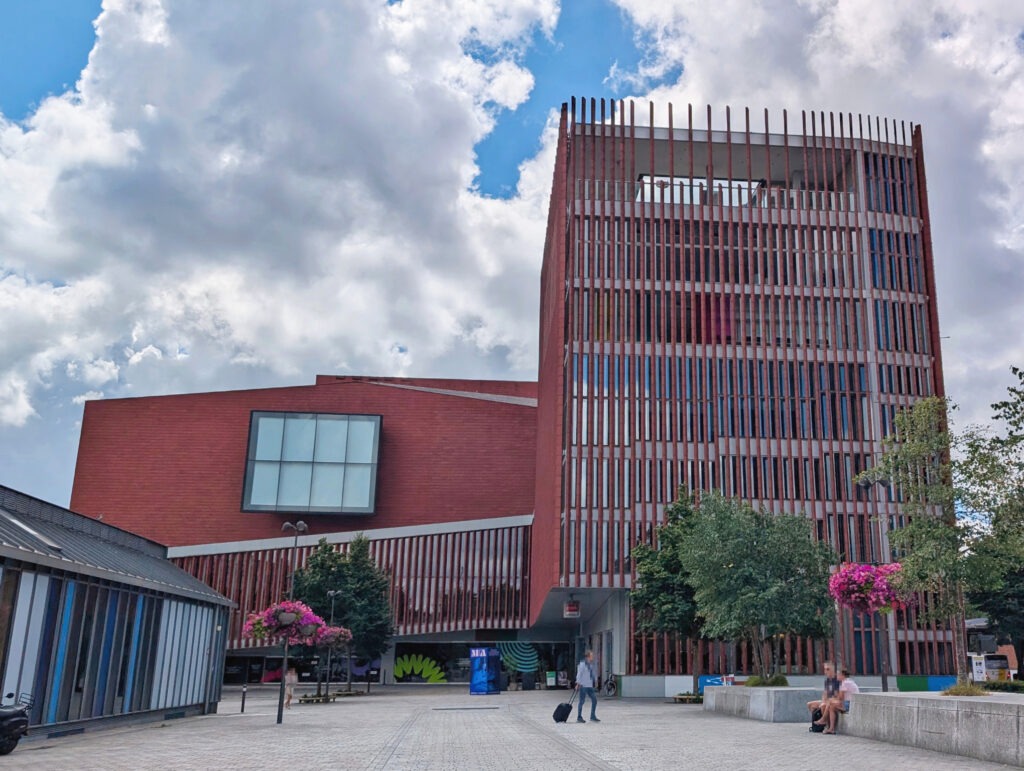
The solid construction and red terracotta tiles give the Concert Hall a distinctive appearance. Famous for its excellent acoustics, it is a central venue for classical concerts, festivals, and cultural events.
If you want to learn more about the building, you can take the Concertgebouw Circuit. However, the partially accessible tour is usually offered only in Dutch — an English version is available upon request.
The Concert Hall itself is accessible only during events or guided tours. The Concertgebouw Café on the ground floor, however, is open to visitors during its regular opening hours.
Bruges Concert Hall – Accessibility Details
- The concert hall is fully accessible via elevators and ramps, though some ramps are relatively steep.
- Some doors can be difficult to open.
- There are several accessible toilets, with the most convenient located near the cloakroom and in the Lantern Tower.
- Access to the Concertgebouw Café is via a 5.4 in (90 cm) wide door that can be somewhat difficult to open.
- Concertgebouw Circuit: Not entirely step-free. Wheelchair users are provided with an iPad featuring a video tour for areas they would otherwise miss.
Directions:
The wheelchair-accessible walking tour of Bruges starts at the Concert Hall. There is a public accessible toilet 🚻 on the square in front of the hall. From there, with the Concert Hall at your back, cross the square and turn right in the middle onto the shopping street Zuidzandstraat, which leads directly to St. Salvator’s Cathedral.
St. Saviour’s Cathedral (Sint-Salvatorskathedraal)
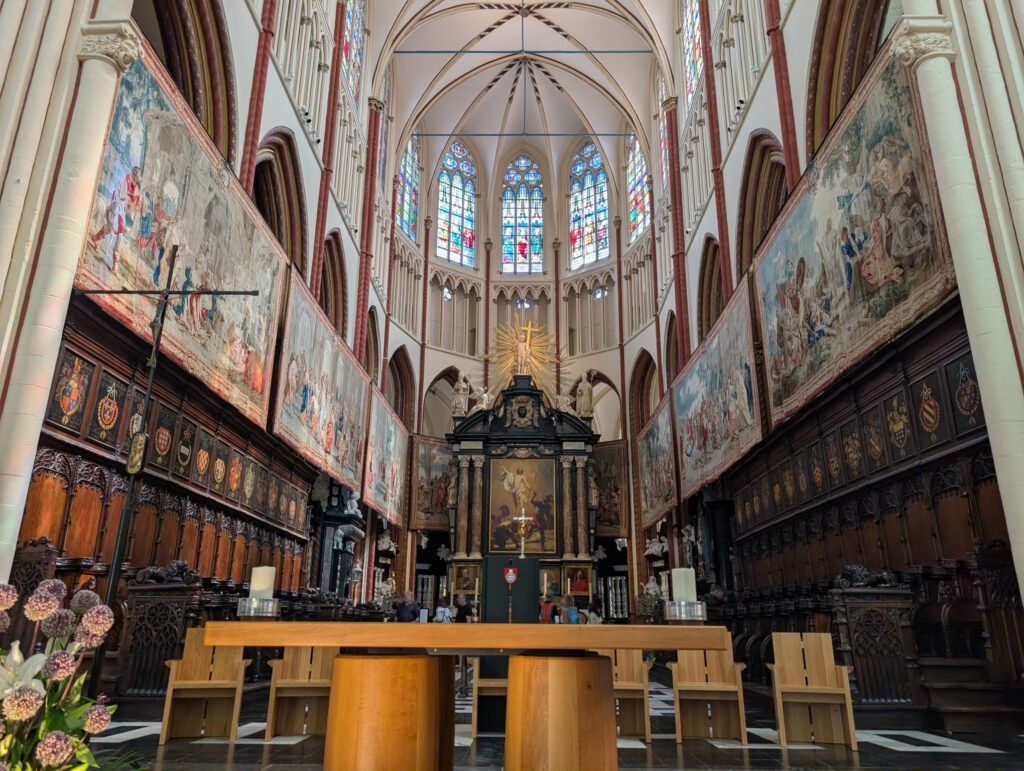
St. Saviour’s Cathedral is the oldest church in Bruges and has served as the bishop’s seat since 1834. It combines elements of Flemish brick Gothic with later additions in Neo-Gothic and Neo-Romanesque styles. Particularly striking are the tall west tower and the ring of chapels with their characteristic conical roofs.
Inside, you’ll find Baroque altars, impressive stained-glass windows, and valuable works of art. Highlights include the tapestries and the intricately carved choir stalls around the main altar, as well as the Baroque organ loft. You can also admire paintings by renowned Flemish artists such as Dirk Bouts and Hugo van der Goes.
Many of these pieces come from the church’s treasury and can be viewed in the adjoining museum, the Treasury.
St. Saviour’s Cathedral – Accessibility Details
- The cathedral is mostly step-free.
- Some areas are accessible via ramps.
- The Treasury is only accessible via stairs.
Directions:
After visiting St. Saviour’s Cathedral, we walk counterclockwise around the church until we reach Heilige-Geeststraat. We then follow this street straight to the Church of Our Lady.
Church of Our Lady (Onze-Lieve-Vrouwekerk)
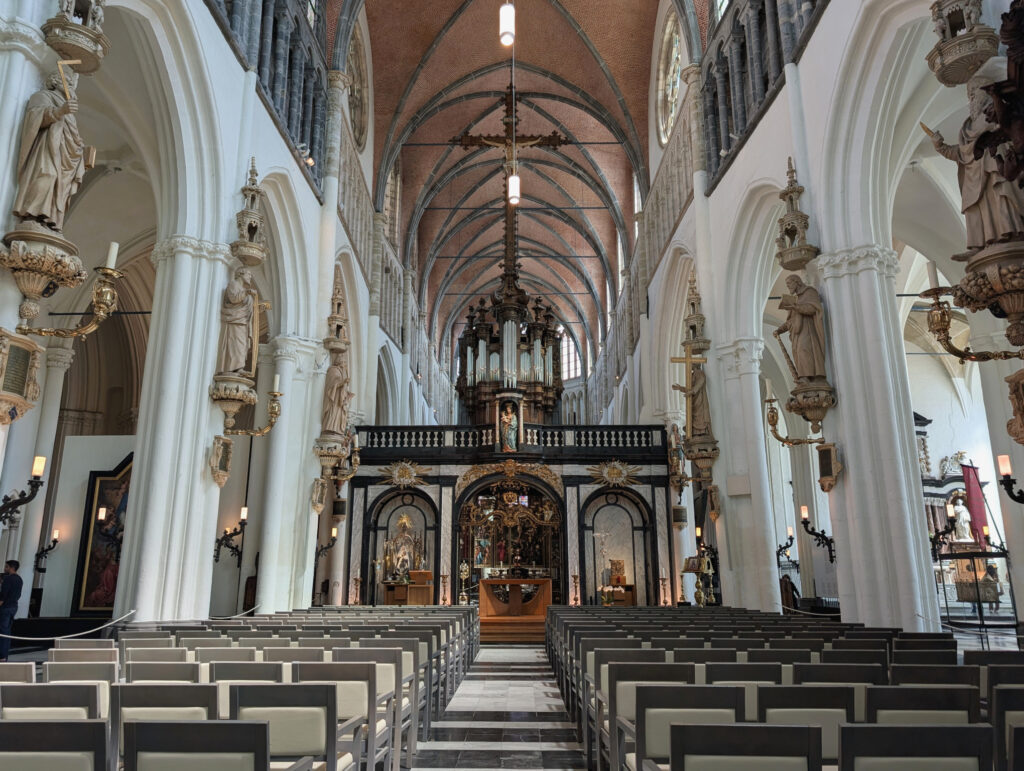
Built in the Gothic style, the Church of Our Lady is one of the oldest places of worship in Bruges and shapes the cityscape with the second-tallest brick tower in the world. The church is divided into two sections: one is freely accessible, while the other houses the Museum of the Church of Our Lady. You can access the official text guide directly on your smartphone via Explorer – Musea Brugge.
In the freely accessible section, you can view the nave, the main altar, and the richly decorated Rococo pulpit. You can also see artworks such as the reliquary arm of Saint Anthony the Great, who was long venerated as a patron against the plague.
In the Museum of the Church of Our Lady, you’ll find the centerpiece: Michelangelo’s Madonna and Child in white marble. It is the only sculpture to have left Italy during the Renaissance master’s lifetime. You can also see the ornate tombs of Mary of Burgundy and Charles the Bold, as well as the Passion Triptych in the high choir.
Church of Our Lady – Accessibility Details
- The church is step-free accessible via a steep ramp at the entrance (assistance may be required).
- The high choir and the altar with Michelangelo’s Madonna and Child are easily reachable via ramps.
- The path around the tombs is relatively narrow.
Directions:
After leaving the church, turn sharply left and follow Mariastraat until you reach a passage on the right at the level of the church. Through this passage, you arrive at St. John’s Hospital.
St. John’s Hospital (Sint-Janshospitaal)
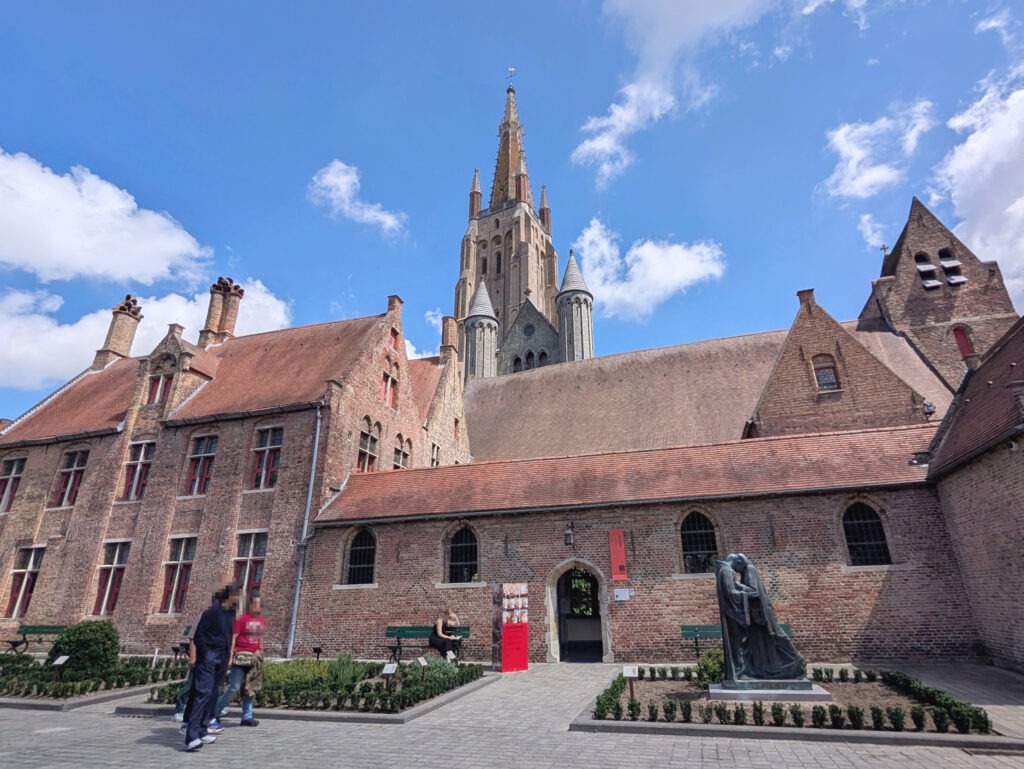
St. John’s Hospital is one of the oldest hospital buildings in Europe and today invites visitors to explore both the museum and the historic hospital pharmacy. Both areas can be visited with a combined ticket, or you can purchase a separate ticket for the pharmacy only. The free museum audio guide can be accessed directly on your smartphone via Explorer – Musea Brugge.
In the museum, you’ll dive into more than 800 years of caregiving history. The exhibition presents historical medical instruments, furniture, and objects that reflect the sisters’ work and the hospital’s long tradition of hospitality. Highlights include the seven works by Hans Memling, among them the famous Shrine of St. Ursula. With the Closer to Memling Experience, you can explore these masterpieces interactively.
The pharmacy of St. John’s Hospital was founded in 1643. Its largely preserved original interior offers a fascinating glimpse into the period. In front of the pharmacy, small herb beds invite you to linger and illustrate how the sisters once prepared their remedies.
St. John’s Hospital – Accessibility Details
Museum:
- Most areas are step-free.
- An elevator is available.
- One gallery is reached via a platform lift.
- Some ramps are relatively steep (assistance may be required).
- An accessible toilet is available.
Pharmacy:
- The entrance has two steps, which can be bridged with a board on request.
Directions:
We exit Saint John’s Hospital via the same passage we entered. Then we keep slightly to the right and reach the street O.-L.-Vrouwekerkhof-Zuid. We follow the street and walk counterclockwise around the Church of Our Lady. Along the way, we’ll pass the picturesque Boniface Bridge (Bonifaciusbrug), a popular photo spot 📸. Although the bridge itself is not accessible due to steps, you can easily take a photo from the side — and it’s well worth it.
Along the way, we pass the also non-accessible Gruuthuse Museum, where a public accessible toilet 🚻 is located opposite the information desk. Shortly after, we return to the entrance of the Church of Our Lady. Here, we turn right onto Mariastraat and, after a few meters, reach Simon
Stevin Square. Several restaurants have step-free entrances, inviting you to take a break. If you’re not ready to eat yet, you’ll find more wheelchair-friendly options further along the route.
We cross Simon Stevin Square and, at the end, turn onto Steenstraat. This lively shopping street leads us directly to the Market Square (Grote Markt), the heart of Bruges. In addition to several restaurants, you’ll find major attractions here: the City Halls with the impressive Belfry, Provincial Court, and the interactive Historium Brugge.
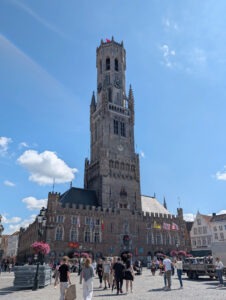
The Belfry of Bruges is one of the city’s most famous landmarks and part of the UNESCO World Heritage Site. From the top, you can enjoy a fantastic view over the rooftops of Bruges – if you’re able to climb the 366 steps to the viewing platform. Unfortunately, there is no wheelchair access to the platform. If your companion plans to make the climb, we recommend purchasing tickets online in advance, as they often sell out quickly. In the Belfry’s courtyard, you’ll find a public accessible toilet 🚻.
Provincial Court (Provinciaal Hof)
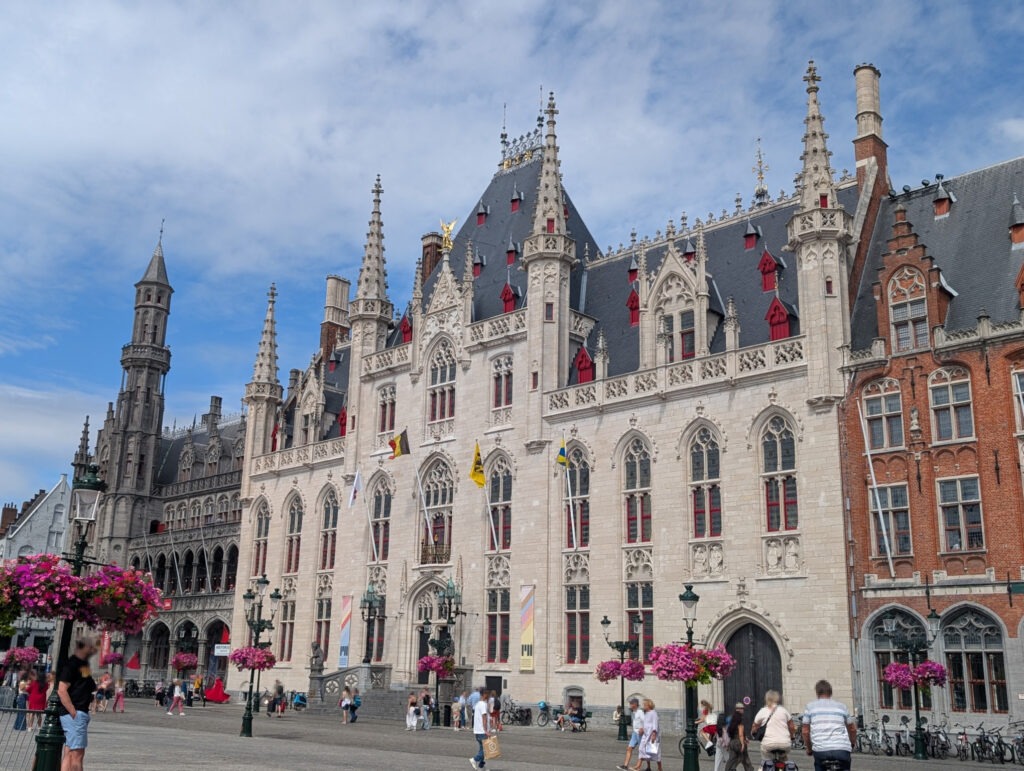
The Provincial Court is an impressive example of Neo-Gothic architecture with a rich history. Originally, the site housed the Gothic Water Hall and later a Neoclassical residential complex. From the 1870s until 1999, it served as the administrative center for the Province of West Flanders. Today, the building functions as an information center, event venue, and museum.
To explore the magnificent Neo-Gothic halls of the Provincial Court, you can either join a guided tour or use the English-language audio guide (approx. 40 minutes). For children, an English-language scavenger hunt is available.
In the courtyard café, you can enjoy West Flemish specialties, while the courtyard shop offers regional products. Another highlight is the exhibition „Court of Things“, where everyday objects from the region tell their fascinating stories until mid-2027.
Additionally, on the second floor, there is an accessible toilet 🚻 that wheelchair users can use free of charge during opening hours.
Provincial Court – Accessibility Details
- The entire building is step-free accessible.
- The main entrance has a staircase. To the right of it (behind a wooden door) is an elevator providing step-free access to the building.
- Inside, additional elevators allow step-free access to all floors.
Accessible “Toilet for All” on the second floor:
- Features: Toilet with height-adjustable adult changing table and ceiling lift (“Toilet for All”)
- Access: Free, registration at the reception (ground floor)
- Narrowest Passage to Toilet: 35.4 in (90 cm)
- Clearance in Front of Toilet Bowl: 59 in (150 cm)
- Approach to Toilet Bowl: from both sides
- Grab Bars at Toilet Bowl: 2 fold-down grab bars
- Height of Toilet Bowl: 18.5 in (47 cm)
- Sink: wheelchair-accessible underneath
Accessible Toilet in the Basement:
- Access: Paid
- Narrowest Passage to Toilet: 35.4 in (90 cm)
- Clearance in Front of Toilet Bowl: 47.2 in (120 cm)
- Approach to Toilet Bowl: from the left (37.4 in / 95 cm)
- Grab Bars at Toilet Bowl: 1 fold-down grab bar and 1 wall-mounted grab bar
- Height of Toilet Bowl: 18.5 in (47 cm)
- Sink: wheelchair-accessible underneath
Historium Brugge
The Historium Brugge is not a traditional museum, but an immersive experience offering a variety of activities that can be booked individually or as a combined ticket. Rather than presenting dry facts, it brings medieval Bruges to life with films, sets, and soundscapes. The museum is particularly family-friendly, thanks to its playful approach. For history enthusiasts, it’s important to know that the exhibition tells a fictional story set in medieval Bruges – it is not a conventional historical display.
The Historium story takes you through seven themed rooms. Along the way, you follow Jacob, the apprentice of the painter Jan van Eyck, and Anna, who is to model for one of his paintings. Each room depicts a different scene of Bruges in 1435. An English-language audio guide provides narration for the scenes.
Additionally, you can book a ticket for a virtual reality experience. This involves a ten-minute flight over medieval Bruges, showing buildings that no longer exist today – such as the Water Hall or St. Donatian’s Church. A complementary exhibition afterwards provides historical context for what you’ve seen.
The Historium also features a paid observation tower offering views over the Market Square, but it is only accessible via 145 steps. For a more relaxed visit, you can reach the Duvelorium beer bar on the first floor by elevator (outdoor terrace not wheelchair-accessible).
Historium Brugge – Accessibility Details
- The museum is step-free, except for the observation tower and the panoramic terrace.
- The main entrance has six steps; around the corner to the right, there is an elevator to the museum’s entrance hall.
- Inside the museum, there is an additional elevator.
- The Historium Story follows a fixed route. All rooms of the tour are wheelchair-accessible. Wheelchair users occasionally need to leave the main route to take an alternative path with an elevator. This can briefly interrupt the narrative.
- Some scenes in the Historium Story have well-paved cobblestones.
- A maximum of two wheelchair users is allowed per session. High demand may result in waiting times.
- The outdoor terrace of the Duvelorium beer bar has a 5.9 in (15 cm) step and a relatively high railing, so wheelchair users have only limited views of the Market Square.
Accessible Toilet (1st Basement):
- Narrowest Passage to Toilet: at least 35.4 in (90 cm)
- Clearance in Front of Toilet Bowl: 47.2 in (120 cm)
- Approach to Toilet Bowl: no side access
- Grab Bars at Toilet Bowl: 1 fold-down grab bar and 1 wall-mounted grab bar
Directions:
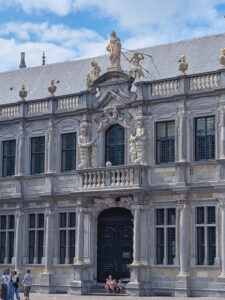
We leave the Market Square at the height of the Belfry and follow Breidelstraat. After a short distance, we reach Burg Square (De Burg) and keep to the right. In the corner of the square you’ll find the famous Basilica of the Holy Blood, with the City Hall located just to its left.
Basilica of the Holy Blood (Basiliek van het Heilig Bloed)
The Basilica of the Holy Blood is a truly unique church in Bruges, impressing visitors with the striking contrast between its two chapels. The austere Romanesque lower chapel stands in sharp contrast to the richly decorated Neo-Gothic upper chapel.
The upper chapel was originally built in the 15th century in the Gothic style and houses the famous Holy Blood relic, which is said to have been brought to Bruges by Crusaders. The relic is a cloth believed to be soaked with the blood of Jesus. Every year on Ascension Day, the relic is carried through the city in a procession.
The basilica’s museum houses numerous precious artworks related to the veneration of the Holy Blood. A standout piece is the Shrine of the Holy Blood, crafted by Jan Crabbe in 1614 from gold and silver, decorated with over 100 gemstones.
Basilica of the Holy Blood – Accessibility Details
- The basilica, including the museum, is fully step-free accessible.
- The lower chapel is step-free and accessible from the ground floor.
- An elevator to the upper chapel and the museum is located to the left of the staircase (with an intercom and call button).
- The narrowest entrance to the upper chapel and museum is 33.5 in (85 cm) wide.
- Turning spaces are partially limited.
- Some doors are difficult to open.
- There are relatively steep ramps.
- Some exhibits in the museum may be difficult to view from a seated position.
City Hall (Stadhuis)

The City Hall is one of the oldest in the Netherlands and has served as the center of city administration for over 600 years.
A true highlight of the City Hall is the Gothic Hall, which was elaborately renovated in the Neo-Gothic style in the 19th century. Today, you can still admire it in its original splendor, complete with the ornate vaulted ceiling and historic wall paintings.
Right next door is the Historical Hall, where a projection table illustrates Bruges’ historical connection to the sea. The accompanying audio is provided by a guide available in English, French, and Dutch.
A free English audio guide for smartphones is available for the Gothic Hall and the ground floor through: Explorer – Musea Bruges.
Important: The Gothic Hall and the Historical Hall are not accessible during weddings.
City Hall – Accessibility Details
- The entire City Hall is step-free accessible via an elevator.
- The narrowest passage is at least 35.5 in (90 cm) wide.
- The elevator door is relatively difficult to open.
- There are toilets available, but none are wheelchair-accessible.
Directions:
We leave the City Hall and keep to the right. On the left is the Liberty of Bruges (Bruges Vrije). Due to the very steep mobile entrance ramp (30% incline), we don’t consider it especially worth visiting for wheelchair users. However, you can check out what the site offers using the free audio guide Explorer – Musea Bruges and decide for yourself whether to take on the challenging access.
Just before the Liberty of Bruges, we turn right onto Blinde-Ezelstraat and follow it over a bridge. We then keep right again and cross the small square Huidenvettersplein, lined with numerous restaurants. At the end of the square, a passage leads back to the Dijver Canal, where you’ll find the Rosary Quay (Rozenhoedkaai) – one of Bruges’ most famous photo spots 📸.
At the junction, we keep to the right and follow the canal.
Optional route to the brewery „Bourgogne des Flandres“:
Those interested in learning more about Belgian beer culture can make a detour to the brewery „Bourgogne des Flandres.“ The round trip is only about 820 ft (250 m). To reach the brewery, we turn right at the first bridge, the Nepomuk Bridge (Nepomucenusbrug), and then left at the next opportunity. We follow Kartuizerinnenstraat to the brewery. After the visit, we retrace our steps back to the Nepomuk Bridge.
Brewery „Bourgogne des Flandres“
During a visit to the Bourgogne des Flandres brewery, you’ll discover everything about the ingredients, brewing process, and history of Belgian beer. The self-guided tour includes English explanations at each station, along with an English audio guide and a video on the history of beer.
In the attic, you can experience the aromas of malt and hops up close and ask the brewmaster questions. In the interactive area, you can learn to pour beer digitally or design your own bottle with a photo label, which you can purchase at the end of the tour. The experience concludes with a beer tasting.
The beer „Bourgogne des Flandres“:
This reddish-brown beer reflects the Flemish tradition of blending young and old beers. „Bourgogne des Flandres“ is a mix of „Den Bruinen Os,“ brewed in Bruges, and Lambic from the Timmermans brewery, aged for twelve months in wooden barrels.
Brewery „Bourgogne des Flandres“ – Accessibility Details
- Almost the entire brewery is step-free accessible via an elevator.
- The narrowest passage is 33.9 in (86 cm) wide.
- Wheelchair access to the brewery is via the bar entrance.
- In the exhibition area, three steps must be negotiated using a mobile ramp.
Bar:
- The bar is accessible over a 2 in (5 cm) threshold.
- Indoor tables have limited wheelchair clearance.
- The courtyard terrace is step-free and features beer tables with benches.
- The terrace by the water is only accessible via steps.
Accessible toilet (1st basement):
- Narrowest Passage to Toilet: at least 34.3 in (87 cm)
- Clearance in Front of Toilet Bowl: at least 47.2 in (120 cm)
- Approach to Toilet Bowl: from the left (at least 35.4 in / 90 cm)
- Grab Bars at Toilet Bowl: 1 fold-down grab bar
Directions:
We cross the street at the Nepomuk Bridge and follow the canal. After about 980 ft (300 m), we come to a row of trees. Since the path under the trees is unpaved, we cross the Dijver Street at a suitable location with a lowered curb. We then follow the street on the left side until reaching Groeninge Street. Here, we turn left and continue until a gate with a “Groeninge Museum” sign appears on the left.
Those wishing to visit the “Groeninge Museum” or the BRUSK Art Hall enter through this gate.
Groeninge Museum
The Groeninge Museum is the most renowned Museum of Old Masters in Bruges and a must-visit for anyone interested in painting. Here, you can experience six centuries of Belgian art – from the Flemish Primitives to 20th-century modern art. Particularly impressive are the works of Hans Memling, Jan Provoost, and Gerard David. Their paintings illustrate why Bruges was a center of European painting in the late Middle Ages.
The museum also houses Neoclassical works, Flemish Expressionism, and modern art.
Here too, you can explore the exhibition using the MB Explorer on your smartphone.
Groeninge Museum – Accessibility Details
- The entire museum is step-free accessible.
- The ramp to the museum shop and the first exhibition room is relatively steep.
- A revolving door leads to the ground-floor exhibition rooms, which can be opened if needed to allow direct wheelchair access.
- The elevator door to the multipurpose room is 34.3 in (87 cm) wide.
Accessible toilet (near the museum shop):
- Narrowest Passage to Toilet: at least 34.3 in (87 cm)
- Turning spaces are partially limited.
- Space Between Toilet and Sink: 31.5 in (80 cm)
- Approach to Toilet Bowl: from the left (at least 35.4 in / 90 cm)
- Grab bars at Toilet Bowl: 1 fold-down grab bar
BRUSK Art Hall
Opening May 8, 2026
The BRUSK Art Hall is Bruges’ newest destination for art and culture. It presents rotating exhibitions where historical and contemporary works come together, creating surprising connections between the past, the present, and other cultures. BRUSK combines objects from the Musea Brugge collection with loans from international museums, offering discoveries across multiple time periods and continents.
BRUSK Art Hall – Accessibility Details
- The art hall is fully accessible via elevator.
- There is an accessible toilet.
Directions:
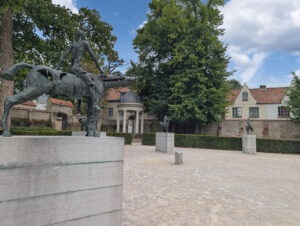
Opposite the gate to the Groeningemuseum is another gate. We pass through this gate and enter the Hof Arents, which offers a beautiful view of the Church of Our Lady and several benches for resting. The park also features Rik Poot’s sculpture group, “The Four Horsemen of the Apocalypse“. We leave the park through the left gate and follow Groeninge Street over a bridge. Shortly after, we turn right onto Kastanjeboomstraat. At the end of the street, we turn left onto Katelijnestraat and continue to Walstraat, where we turn right. We continue along the street to Walplein, a small square with several restaurants under the trees, perfect for a relaxing break.
Opposite the restaurants is the “De Halve Maan” brewery, where you can also learn more about Belgian brewing. The classic brewery tours are offered in Dutch, French, and English, but involve climbing 220 steps. A wheelchair-accessible alternative is available as a digital tour on a tablet, accompanied by small samples of the brewing ingredients to illustrate the process interactively. The brewery also features a souvenir shop and an on-site restaurant, which are step-free accessible via an elevator, although the cobblestone path leading there is somewhat uneven.
We continue straight past the brewery until we reach Wijngaardstraat, where we turn right. After a few meters, a bridge appears on the right, leading to a walled area – the Beguinage. As this entrance is difficult to navigate in a wheelchair, we stay on the street and follow it along the canal, crossing a bridge until its end. There, we turn right and cross another bridge. On the left stands the historic Lock House. Those who wish to visit the Beguinage can simply continue straight through the large gate after the bridge.
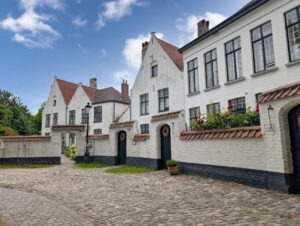
The Bruges Beguinage is one of those quiet retreats you can discover amid the bustling city. Founded in 1245 and now a UNESCO World Heritage Site, it was originally home to Beguines – women who did not take formal vows but lived according to rules of poverty, chastity, and regular prayer. Today, the Beguinage is home to both nuns and single women.
Around the central courtyard with its shady trees, you’ll find several small, charming houses as well as the Baroque Beguinage Church (main entrance with two steps | step-free side entrance with a bell that is only occasionally attended). To enter the courtyard, you first navigate a short stretch of historic cobblestones. The paths around the complex are then relatively easy to traverse by wheelchair.
After your visit, you exit the Beguinage the same way back to the Lock House.
From the bridge at the Lock House, we follow the road along the lake to a right-hand bend. Here we continue straight ahead, following the path along the shore past a public, accessible toilet 🚻.
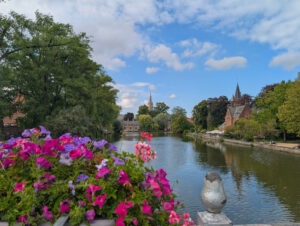
The lake we’re walking alongside is the Lake of Love (Minnewater). In stark contrast to the bustle of the old town, it radiates an almost magical calm. The view of the Neo-Gothic de la Faille Castle on the opposite side is particularly inviting for a brief pause. At the end of the path stands the Powder Tower. The bridge there offers a fantastic photo spot 📸 – with the lake in the foreground and the historic city of Bruges in the background.
We leave the bridge toward the Powder Tower and continue straight ahead. The path is divided: pedestrians on the left, cyclists on the right. Since the pedestrian path is unpaved, wheelchair users are advised to use the asphalted bike path. At the end of the path, turn left and cross the street at the traffic lights. Immediately afterward, take the second set of lights slightly to the right and follow the paved path through the „King Albert I“ Park. After about 0.37 miles (600 meters), you will reach the Concert Hall again, the starting and ending point of our tour.
Additional Wheelchair-Accessible Attractions
The following attractions are slightly off the main wheelchair-accessible route but are also step-free.
Bruges Royal Municipal Theatre (Stadsschouwburg)
At the Royal Municipal Theatre (website in Dutch), you’ll find not only plays but also concerts and dance performances. While the plays may not be understandable without Dutch, the concerts and dance shows often have something interesting to offer. Checking the current program can definitely be worthwhile.
Bruges Royal Municipal Theatre – Accessibility Details
- The theater is fully accessible via an elevator.
- There are designated wheelchair spaces, which can only be reserved by phone or email (bespraakbureau@brugge.be).
- The step-free side entrance has a 16 in (40 cm) ramp with a 14.5 % incline.
- The narrowest passage is at least 35 in (90 cm) wide.
Accessible toilet (ground floor):
- Narrowest Passage to Toilet: at least 35 in (90 cm)
- Turning Space Inside Toilet: 45 in (114 cm)
- Approach to Toilet Bowl: from the right (at least 35 in / 90 cm)
- Grab Bars at Toilet Bowl: 1 fold-down grab bar and 1 wall-mounted grab bar
Belgian Fries Museum (Frietmuseum)
Belgium is not only famous for its chocolates and beer, but of course also for its fries! Whether they are truly the best in the world is something you’ll have to decide for yourself. If you want to learn more about the history and preparation of Belgian fries, the Fries Museum is the perfect place. You might even get to settle the legendary debate: are fries really from Belgium, or from France?
The exhibition is quite entertaining and is dedicated to the history of the potato and its transformation into the beloved golden fries. Overall, the museum is more geared toward families and children. In the basement, you can even enjoy a fresh portion of fries.
Belgian Fries Museum – Accessibility Details
- Electric wheelchairs and walkers are not allowed in the museum.
- The entire museum is step-free accessible via an elevator.
- Some areas inside the museum are narrow.
- Exhibits in the display cases are only partially viewable from a seated position.
- The snack bar in the basement is accessible via the elevator.
Accessible toilet (1st floor):
- The toilet is not suitable for wheelchair users.
- Due to its small size and the inward-opening door, the door cannot be closed when a wheelchair is inside.
- The turning radius in the toilet is 35 in (90 cm).
Lace Centre (Kantcentrum)
Since the 15th century, Bruges has been a center of lace making. Bruges bobbin lace in particular gained worldwide fame. If you’re interested in traditional crafts or want to learn how the finest lace is created through meticulous handwork, a visit to the Lace Center is highly recommended.
The museum is housed in the former lace-making school of the Apostoline Sisters and tells the story of this delicate craft, from its origins to contemporary lace. Between 2:00 and 5:00 pm (Monday to Saturday, except on public holidays), you can watch skilled lacemakers at work and see how fine threads are transformed into intricate patterns.
The museum also offers courses and workshops where you can learn the art of lacemaking yourself. If you prefer a more relaxed experience, the shop sells handmade lace – a lovely souvenir of your visit.
Lace Centre – Accessibility Details
- The entire museum is step-free accessible via an elevator.
- The narrowest passage is at least 35 in (90 cm) wide.
Accessible toilet (1st floor):
- Narrowest Passage to Toilet: at least 35 in (90 cm)
- Turning Space Inside Toilet: at least 59 in (150 cm)
- Approach to Toilet Bowl: from the left (at least 35 in / 90 cm)
- Grab Bars at Toilet Bowl: 1 fold-down grab bar and 1 wall-mounted grab bar
Zeebrugge – wheelchair-accessible beach
Zeebrugge is the perfect place to leave the city air behind for a refreshing sea breeze. About 12.5 miles (20 km) from the historic center, the Zeedijk bathing facility (Zeedijk Badengebouw, 8380 Brugge) offers everything you need for a relaxed, wheelchair-accessible day at the beach.
Accessible facilities:
- step-free access to the beach
- wheelchair-accessible toilet, changing room, and shower
- transfer lift
Special services (available only in July & August, by prior reservation):
- beach wheelchairs
- Tiralo, a floating beach wheelchair for access to the sea
- on-site support for disabled visitors
Reservations can be made by email at sociaalbeleid@brugge.be.
The official tourism website provides more information about the wheelchair-accessible beach in Zeebrugge.
Schreibe einen Kommentar